Competent in the field of Civil Engineering to expand the quality of knowledge through research, consultation, writing and publication.
Back to homeOBE &
Quality assurance
OBE &
Accreditation
Programme learning outcomes and accreditation information for postgraduate studies at FKAAB.
QualityOutcome-based educationContinuous improvement
Programme standards
Learning outcomes & accreditation
Official programme information presented by the Department of Postgraduate Studies.
MFAMaster of Civil EngineeringKFAMaster of Civil EngineeringKFBMaster of Built EnvironmentPFADoctor of Philosophy in Civil EngineeringPFBDoctor of Philosophy in Built Environment
MFAMaster of Civil EngineeringCoursework · EnglishView PEO & PLO
03
Programme Educational Objectives
Graduate achievements expected after completing the programme.
Demonstrate excellent leadership through effective communication and cooperation among peers, researchers and stakeholders.
Solve Civil Engineering problems innovatively and creatively, and manage information for lifelong learning.
11
Programme Learning Outcomes
Knowledge, skills and professional attributes developed through the programme.
Apply knowledge critically and integratively to manage and resolve complex Civil Engineering problems using advanced techniques, tools or approaches. (Knowledge and Understanding)
Solve and manage complex Civil Engineering problems through understanding, critical thinking and comprehensive assessment. (Cognitive Skills)
Demonstrate work and operational skills among peers and other groups in planning, organising, selecting tools, materials, technological methods, designs and procedures, and solving problems using Civil Engineering principles. (Practical Work Skills)
Interact effectively through communication and collaboration in managing relationships within teams, among peers or within organisations by using a broad range of information, media and technology applications. (Interpersonal Skills)
Convey information, ideas and reports cogently and professionally in appropriate language using a combination of numerical and graphical or visual data. (Communication Skills)
Manage information effectively through media, software and technology applications for sourcing, storing, processing and problem-solving. (Digital Skills)
Use quantitative, statistical and mathematical approaches to design, analyse and evaluate Civil Engineering problems. (Numeracy Skills)
Display significant autonomy, independence, leadership and interpersonal skills, as well as substantial responsibility in planning, problem-solving and managing work. (Leadership, Autonomy and Responsibility)
Demonstrate enthusiasm for independent learning and intellectual and personal development through confidence, self-control, social skills, etiquette and commitment. (Personal Skills)
Demonstrate creativity and perseverance in leading entrepreneurial ventures. (Entrepreneurial Skills)
Demonstrate adherence to legal, ethical and professional codes of practice in solving complex Civil Engineering problems. (Ethics and Professionalism)
KFAMaster of Civil EngineeringResearch · EnglishView PEO & PLO
03
Programme Educational Objectives
Graduate achievements expected after completing the programme.
Competent in the field of Civil Engineering to expand the quality of knowledge through research, consultation, writing and publication.
Demonstrate excellent leadership through effective communication and cooperation among peers, researchers and stakeholders.
Solve Civil Engineering problems innovatively and creatively, and manage information for lifelong learning.
11
Programme Learning Outcomes
Knowledge, skills and professional attributes developed through the programme.
Demonstrate originality and independence in undertaking analytical and critical evaluation and synthesising complex information, specialised concepts, theories, methods and practices in Civil Engineering as a basis for research. (Knowledge and Understanding)
Conduct standard and specialised research approaches to solve and manage complex Civil Engineering problems through knowledge and understanding of the latest developments. (Cognitive Skills)
Demonstrate professional practical work skills in related work using appropriate methods among peers and experts in Civil Engineering. (Practical Work Skills)
Demonstrate interpersonal skills, including interactive communication and networking, by using a broad range of information, media and technology applications to manage relationships within organisations and communities. (Interpersonal Skills)
Communicate interactively using numerical and graphical or visual data to convey information and ideas cogently in appropriate language. (Communication Skills)
Use a wide range of suitable digital technologies and appropriate software to enhance research, including sourcing and storing information and processing data to support and generate ethical problem-solving solutions. (Digital Skills)
Competently use mathematical and other quantitative and qualitative tools to design, analyse and evaluate numerical and graphical data for solutions to Civil Engineering problems. (Numeracy Skills)
Demonstrate leadership, autonomy and responsibility through the ability to build relationships and work with teams in multidisciplinary settings among peers and experts. (Leadership, Autonomy and Responsibility)
Demonstrate substantial responsibility in independent learning and planning, self-development, resource management and social skills with confidence, self-control and proper etiquette. (Personal Skills)
Demonstrate personal qualities for product and service commercialisation using appropriate entrepreneurial skills. (Entrepreneurial Skills)
Demonstrate adherence to legal, ethical and professional codes of practice to contribute to and solve societal problems. (Ethics and Professionalism)
KFBMaster of Built EnvironmentResearch · EnglishView PEO & PLO
03
Programme Educational Objectives
Graduate achievements expected after completing the programme.
Demonstrate expertise in the Built Environment field to enhance the quality of knowledge through research, writing, consultancy and publication.
Demonstrate effective leadership through communication and collaboration among researchers and stakeholders.
Solve Built Environment problems creatively and innovatively through the application of sustainable practice principles.
11
Programme Learning Outcomes
Knowledge, skills and professional attributes developed through the programme.
Develop a foundation of research knowledge to evaluate, analyse and synthesise complex information and understand specialised theories and concepts in the Built Environment field. (Knowledge and Understanding)
Apply appropriate research approaches and methods in strategies for resolving Built Environment issues and problems. (Cognitive Skills)
Demonstrate professional practical skills in related work and apply appropriate methods when working with colleagues and Built Environment experts. (Practical Skills)
Competently manage and use interactive communication media through various information applications and current technologies to build and manage relationships within organisations and communities. (Interpersonal Skills)
Communicate interactively using a combination of numerical, graphical or visual data to convey information and ideas accurately in appropriate language. (Communication Skills)
Competently operate and manage digital technologies, networks and software applications to enhance research quality. (Digital Skills)
Apply the ability to interpret ideas and situations through numerical information. (Numeracy Skills)
Demonstrate discipline, leadership, autonomy and responsibility within a research team, and the ability to build harmonious relationships. (Leadership, Autonomy and Responsibility)
Practise volunteerism and sustainable development values continuously throughout life in the Built Environment field. (Lifelong Learning)
Demonstrate excellent personal qualities when collaborating with research teams and apply entrepreneurial skills towards sustainable development. (Personal and Entrepreneurial Skills)
Demonstrate compliance with legal, ethical and professional codes of practice to contribute to and solve societal problems based on sustainable practice principles. (Ethics and Professionalism)
PFADoctor of Philosophy in Civil EngineeringResearch · EnglishView PEO & PLO
03
Programme Educational Objectives
Graduate achievements expected after completing the programme.
Competent in the field of Civil Engineering to expand the quality of knowledge through research, consultation, writing and publication.
Demonstrate excellent leadership through effective communication and cooperation among peers, researchers and stakeholders.
Solve Civil Engineering problems innovatively and creatively, and manage information for lifelong learning.
11
Programme Learning Outcomes
Knowledge, skills and professional attributes developed through the programme.
Demonstrate a comprehensive, systematic and integrated acquisition of complex and current critical issues at the most advanced frontiers of knowledge in Civil Engineering. (Knowledge and Understanding)
Critically analyse, evaluate and synthesise new, complex and current critical issues through advanced knowledge, and refine existing concepts and practices in Civil Engineering. (Cognitive Skills)
Demonstrate mastery of practical and technical skills to resolve new, highly complex and emerging problems through the implementation and adaptation of highly advanced and specialised methods in Civil Engineering. (Practical Work Skills)
Demonstrate interpersonal skills, including interactive communication and networking, by using a broad range of information, media and technology applications to manage relationships within organisations, communities and society. (Interpersonal Skills)
Communicate and convey information, insights, ideas and problems, and defend solutions effectively and professionally. (Communication Skills)
Competently use a wide range of suitable digital technologies and appropriate software to enhance research, including sourcing and storing information and processing data to support and generate ethical problem-solving solutions. (Digital Skills)
Competently use mathematical and other quantitative and qualitative tools to design, analyse and critically evaluate numerical and graphical data for solutions to Civil Engineering problems. (Numeracy Skills)
Demonstrate leadership, professionalism and management skills to assume full responsibility with substantial autonomy in conducting engineering and community activities. (Leadership, Autonomy and Responsibility)
Integrate knowledge for lifelong learning with the development of new ideas and solutions by demonstrating self-development, resource management, social skills, etiquette and responsibility for one's own work and career development. (Personal Skills)
Integrate research work for commercialisation using appropriate entrepreneurial skills. (Entrepreneurial Skills)
Demonstrate adherence to legal, ethical and professional codes of practice and sustainable practices to contribute continuously to solving societal problems. (Ethics and Professionalism)
PFBDoctor of Philosophy in Built EnvironmentResearch · EnglishView PEO & PLO
03
Programme Educational Objectives
Graduate achievements expected after completing the programme.
Demonstrate leadership qualities in solving Built Environment issues analytically, critically and creatively at organisational, national or international levels.
Become a recognised expert in research and development within the Built Environment field.
Contribute to the local community by addressing emerging Built Environment issues for the greater good.
11
Programme Learning Outcomes
Knowledge, skills and professional attributes developed through the programme.
Apply scientific, technological, engineering, environmental, humanities and professional ethics knowledge through interpretation and analysis within the Built Environment field. (Knowledge and Understanding)
Identify, analyse, formulate and conduct research on complex problems to reach conclusions based on scientific, architectural, environmental and engineering principles. (Cognitive Skills)
Develop solutions for design-system and complex engineering problems, components or processes that meet specified needs while considering environmental, health, safety, cultural and societal factors. (Practical Skills)
Perform work and function effectively within diverse social settings, and undertake appropriate roles in carrying out assigned tasks. (Interpersonal Skills)
Communicate effectively by justifying design solutions through visual, oral and written media to persuade stakeholders and target groups. (Communication Skills)
Access, apply and integrate digital facilities and resources to develop new knowledge in Built Environment research and development. (Digital Skills)
Use mathematical and other quantitative tools to design, analyse and evaluate numerical and graphical data for the effective resolution of Built Environment problems. (Numeracy Skills)
Demonstrate the ability to initiate, lead, manage and motivate teams in acquiring knowledge, producing research related to the Built Environment field and achieving objectives. (Leadership, Autonomy and Responsibility)
Engage continuously, voluntarily and with motivation in acquiring knowledge to remain current with the latest developments in the Built Environment field. (Lifelong Learning)
Demonstrate entrepreneurial knowledge and capabilities in exploring the Built Environment industry and related creative industries. (Personal and Entrepreneurial Skills)
Fulfil professional and ethical responsibilities as a trusted individual in resolving issues related to the Built Environment, the environment and humanity. (Ethics and Professionalism)
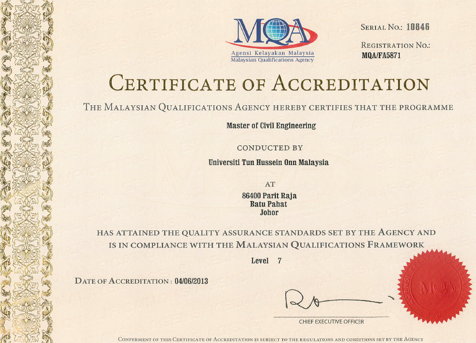
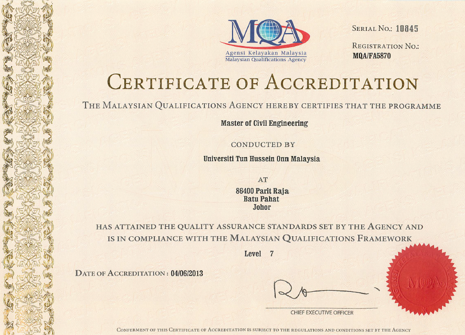
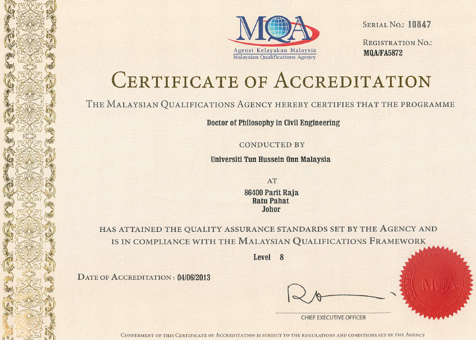
Accreditation certificates
MQA programme recognition
Official certificates currently available for FKAAB postgraduate programmes.
Accreditation contact
Coordinator of Accreditation
Assoc. Prof. Dr. Hilton @ Mohd Hilton Bin Ahmad hilton@uthm.edu.my